

One of the key lessons beginning teachers need to learn is that what we say is only part of the story. How we say it (in lessons and with colleagues) shapes how we are understood, how we are perceived, and ultimately how effective we are. However, when communication isn’t working, it can be hard for a beginning teacher to understand why. Sometimes, they just cannot see it. The different modes and registers of communication used by professionals may not be something they have ever considered. While it may seem obvious that they should not be talking to their colleagues, let alone pupils, like they would to their mates, for some beginning teachers the way they communicate is so intrinsically tied up in their own identity that grasping that this will need to change as they adopt their new teacher identity can feel both impossible and unreasonable.
Targets focused on professional communication often centre on two key areas:
- Communication with pupils in lessons
- Communication with colleagues in feedback and professional dialogue
Knowing what action steps these targets require can be difficult for beginning teachers to conceptualise, so let’s unpack them now.
Communication with pupils: clarity and professionalism over quantity and familiarity
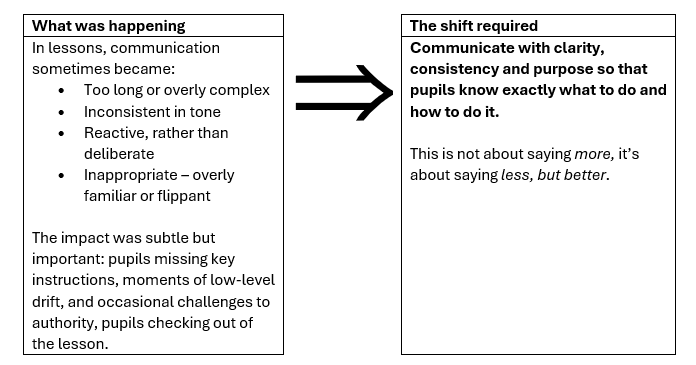
What this looks like in professional practice
Plan the language, not just the task
We often plan what pupils will do, but not how we will explain it. Identifying and rehearsing key instructions in advance makes a difference as when this thinking is done beforehand, explanations become sharper and more confident:
- What is the task?
- How should it be completed?
- What does success look like?
Prioritise economy of language
If an instruction can be given in one sentence, don’t use three. Short, direct phrasing reduces cognitive load and improves pupil comprehension of the task.
Standardise routines and phrasing
Consistency is powerful and familiar language removes ambiguity. Over time, these become automatic cues, reducing the need for repeated explanation:
- “Pens down, eyes this way.”
- “You have 20 seconds to finish your sentence.”
Check, don’t assume, understanding
A common pitfall is asking, “Everyone understand?” before moving on regardless. Instead, build in deliberate checks:
- Ask a pupil to repeat the instruction
- Use targeted questioning
- Pause and scan for readiness
Maintain a professional tone — especially under pressure
Keep language measured and professional, even when behaviour dips. This means:
- Avoiding sarcasm, glib throw-away comments, or overly casual phrasing
- Using calm, neutral corrections
- Keeping the focus on the behaviour, not the individual
In practice, this often means scripting key responses, so you are ready to call on them when needed.
Communication with colleagues: from reaction to reflection
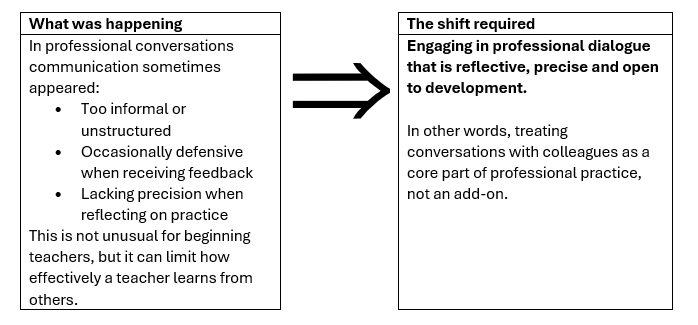
What this looks like in professional practice
Prepare for feedback conversations
The best discussions rarely happen off the cuff; as the ITE year progresses feedback conversations should increasingly be a dialogue rather than a one-way process and preparation helps to achieve this. Before the meeting:
- Identify what you felt went well
- Pinpoint specific areas for development
- Note any questions
Practise active listening
Listening is frequently overlooked as a professional communication skill, but for mentee and mentor it is often more important than the words they speak. Listening can be improved by:
- Letting others finish before responding
- Focusing fully on what is being said
- Not minimising or dismissing what has been said
- Summarising to check understanding
Respond, don’t react, to feedback
It is natural to feel defensive at times. The professional response, however, is different:
- Acknowledge the feedback
- Ask for clarification
- Focus on how to improve
For example, “That’s helpful, Could you model what that might sound like please?”
Use precise language when reflecting
Vague reflections help no one. For example, compare how the first reflection limits improvement while the second creates a clear target for development:
- “That lesson didn’t go well”. ‘v’
- “My instructions were too long, and pupils lost focus during the transition”
Follow through on agreed actions
Returning to previous targets to show what has changed and how this has been achieved is a key marker of a professional committed to acting on advice.
How can mentors help beginning teachers see the need for these changes?
How we communicate is part of who we are. Consequently, beginning teachers can often react quite defensively to critiques about their communication style. In this situation, it is important that the beginning teacher is supported to see for themselves why this is a target. They need help to see themselves objectively as others see them, and to reflect on the impacts of their words/tone/register on the people who heard them. Filming the beginning teacher during a lesson, isolating key episodes with timestamps and providing reflective questions instead of feedback can be transformative.
Instead of the mentor telling, they can replace a statement with a question:
Feedback statement: “When you referred to the task as ‘so simple a fool could do it’, you instantly belittled the person who was unclear about the instruction and made them less likely to ask for help.”
Reflective question: “What was the impact on pupils of the way you referred to the task at 23:31mins? How did that effect their progress in the subsequent task?”
A follow up task might involve the mentor and mentee working together to develop a set of phrases the beginning teacher can use when trying to find ways to introduce an activity or encourage pupils to focus or persist in trying. For example, in this case, the beginning teacher might have found a more positive outcome from saying something like: “I know you are finding this task tricky but you showed in the previous task you have the knowledge you need, so refer back to your notes from that if you’re finding it hard to get started.”
For this beginning teacher, the focus now is on:
- Planning key language as part of lesson preparation
- Using consistent, professional phrasing with pupils
- Engaging actively and openly in feedback conversations
- Reflecting with greater precision
Most beginning teachers just do not know they are saying these things, let alone that the things they say are not received by others with the same intention with which they were spoken. Their communication won’t be fixed overnight. They need to be supported to recognise why it is unprofessional and how it is impacting on others, and to build habits of positive professional communication which will gradually reshape their practice.

