
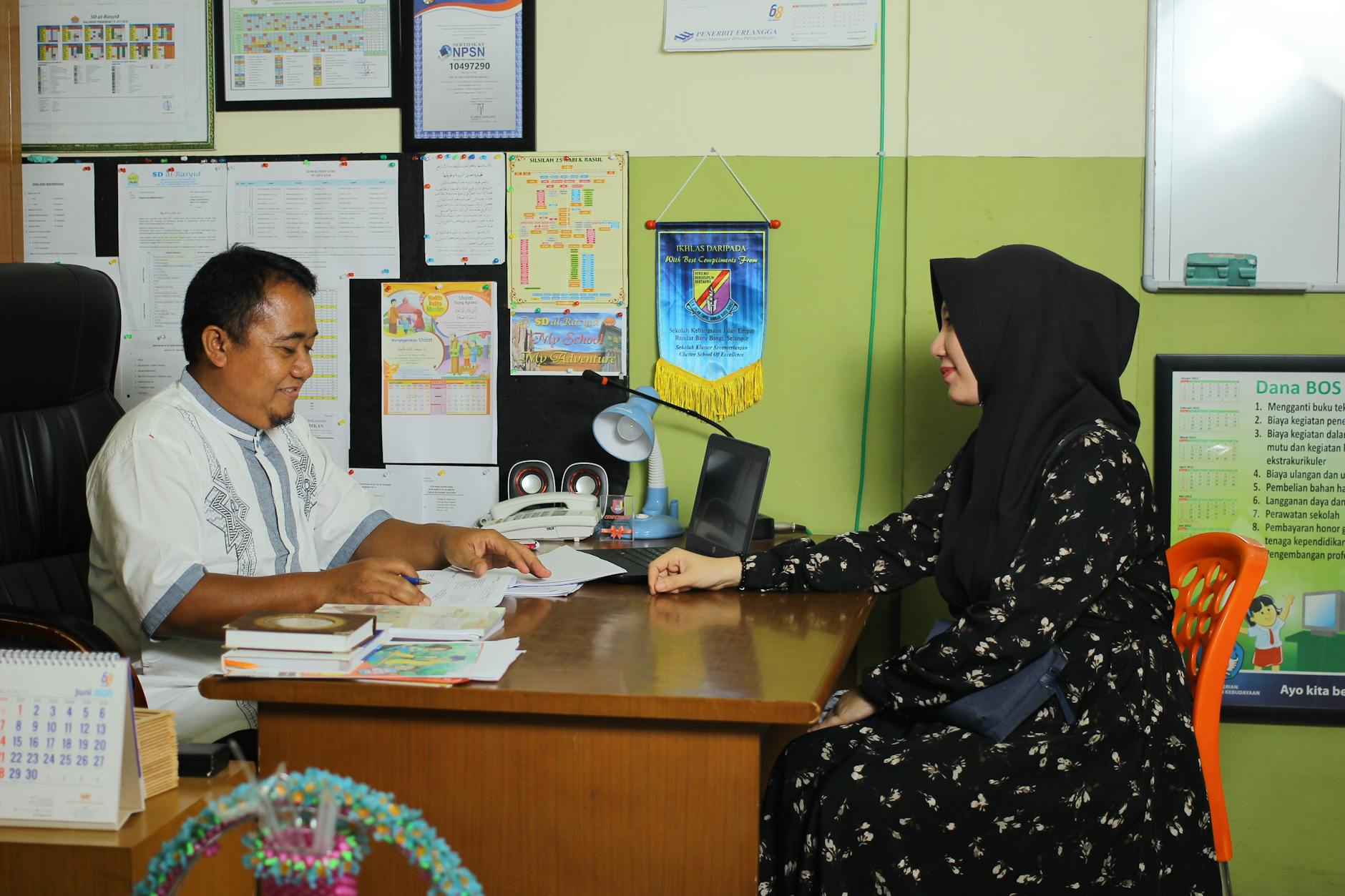
As a parent attending Parents’ Evening consultations, I often find myself glancing at the beginning teacher sitting alongside their mentor on the other side of the table. Inevitably they look a bit overwhelmed by the occasion. While they may have made the odd phone call home, this is probably the first time they’ve met any parents and carers. I remember how scary that feels as a new teacher.
It’s also easy for a beginning teacher to feel like a spare part during these early Parents’ Evenings, but soon enough (quite possibly later on during your training year) you will be the one leading the consultation with parents and carers. This means that, while your mentor is talking, you need to take note of their masterclass in navigating both the logistics and diplomacy of Parents’ Evening conversations.
To move past that feeling of overwhelm, try to focus your attention specific elements of the evening.
- The Preparation
Teachers rarely just rock up to Parents’ Evening with their water bottle and a broad smile. Usually, they come armed with information they need for the consultation to go smoothly.
What information does your mentor prepare prior to Parents’ Evening? Do they prepare it for themselves or for sharing with parents/ carers?
For example, some teachers will simply bring their mark book which contains all the information they need to speak to parents/ carers about the students’ grades, homework completion, and behaviour record. Other teachers will print out a progress slip for each student which holds their individual data for sharing with the parents/ carers. While others will bring their curriculum map or students’ exercise books to talk through during the meeting. They may even prepare scripts for opening the consultation.
2. The Opening Move
The first thirty seconds of a consultation are crucial. Notice how your mentor sets the tone. They have to build a bridge of trust with a stranger almost instantly.
How do they greet the parent/ carer? Do they start with a specific, positive anecdote about the student that proves they really know them?
For example, a generic “they’re doing fine” doesn’t build rapport. A comment like “I loved their contribution to our debate on the Peasants’ Revolt” does. Similarly getting confused about which pupil is sat in front of you can instantly undermine the consultation. Many teachers will come to parents evening armed with a print out of the photo-register for the class to try and avoid this happening (one year I taught 5 children with the same first name who all had very similar hairstyles for one hour a week – distinguishing who was who was hard at the best of times, never more so than under pressure at Parents’ Evening).
3. Translating Teacher-Speak
Teachers live in a world of data, assessment objectives, and curriculum jargon. Parents/ carers usually don’t. Watch how your mentor translates the progress of a student into parent-speak. Professionalism in this context isn’t about using the right words; it’s about making sure the parent/ carer leaves with a clear understanding of where their child stands.
When your mentor explains a grade, do they use abstract numbers or describe the student’s progress in terms of concrete knowledge and skills?
For example, instead of “they are a Grade 5,” they might say “They can explain what happened, but we are working on explaining why it mattered.”
4. Handling the Hard Conversation
Inevitably, some conversations are difficult. A student might be falling behind or disrupting the learning of others. This is probably where you can learn the most about professional diplomacy from observing your mentor in action.
How does your mentor deliver a critique without putting the parent on the defensive?
For example, you are likely to observe teachers choosing their language carefully when trying to raise a concern about a student. They may use the classic sandwich technique (starting with a strength, addressing the concern clearly, and ending with a positive shared plan for improvement). However, this is rarely sufficient on its own. They will also probably use collaborative phrasing such as “How can we work together to support them with their homework?” to keep the parent/ carer on their side and establish that parents/carers and teachers are in it together, trying their best for the student.
5. Reading the Room
Parents’ Evening is as much about listening as it is about talking. Parents/ carers will often drop information into the conversation about why a student might be struggling—they have a significant extra-curricular sports commitment, the family is under stress, or they just don’t get a certain topic. They may also come with questions they really want answered about their child’s progress or the school’s approach to an aspect of learning/ school life. Being in transmit mode for the entire consultation doesn’t make the most productive use of this important time you have with your students’ adults.
How does your mentor provide opportunities for parents/ carers to feel listened to? How do they react to new information or questions?
For example, the teacher may make a note of new information in their mark book or adapt their advice on the fly to recognise the context they’ve just learnt about. If time is tight, they may plan to continue the conversation at another time or refer the concerns/ issues on to a colleague such as the Head of Year.
6. Wrapping it up
The main challenge of Parents’ Evening is running to time (unless you’re in a school that sounds a buzzer at intervals or using online software). Observe carefully how your mentor signals the end of the appointment and starts to wrap up.
How does your mentor use their body language to signal time is up? Does your mentor have a phrase they use with each parent to end the consultation?
For example, some teachers will clear their throat, lean forward (as if about to raise from their chair), and use a phrase such as “Well thank you for coming, it is good to be able to work as a team”.
Making it count
Next time you’re sitting alongside your mentor at Parents’ Evening, keep a small notebook handy. Record what was said and how it was said. After the session, ask your mentor questions to help you understand their thinking: “I noticed you handled that question about the mock exam by doing X—why did you approach in that way?”
And, most of all, remember that parents/ carers generally just want the best for their child and want to work with their teachers to get them to a positive outcome. If they feel you’re invested in their child’s progress, the whole thing becomes a positive opportunity rather than a threat. Hopefully going into your next Parents’ Evening with key things to spot, you’ll find that the scary meeting becomes a lot more manageable when it’s finally your turn to lead the conversation.
 Becoming a History Teacher