

Recently, I encountered this tweet passing on wisdom to mentors about to receive a new Initial Teacher Training/ Initial Teacher Education (ITT/ ITE) student for their second teaching practice placement:
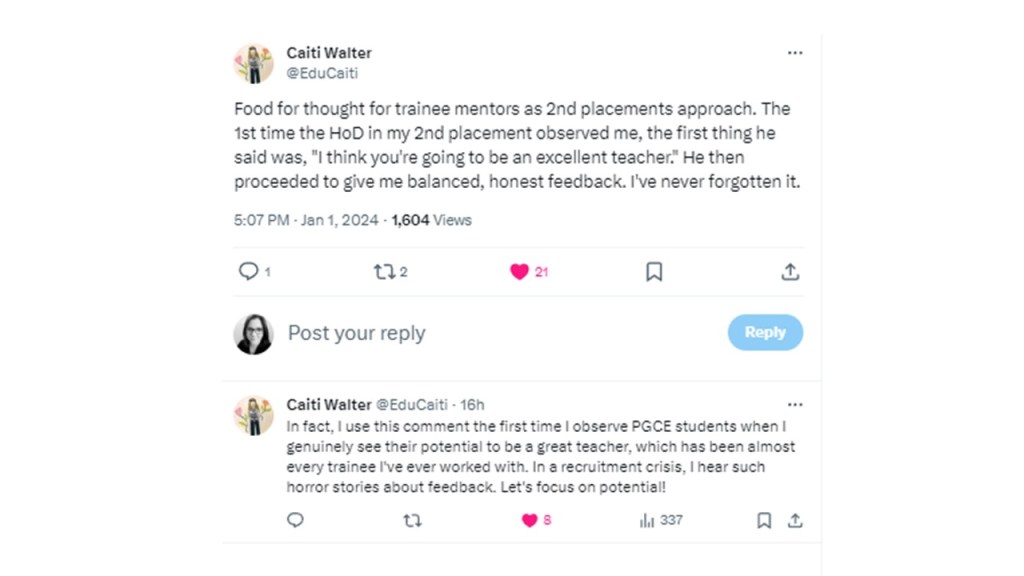
I have previously talked about why it can be difficult for ITE students when they change placement during their training year: A shape-sorter understanding: Why mentees find changing teaching placements so hard. I’ve also spotlighted the particular challenge that confronts beginning teachers who have experienced particularly successful first teaching practice placements: Keeping Toby flying: How to avoid clipping your new mentee’s wings. And I have expounded on the need to reflect on the kind of mentor you are when you give feedback Strictly Come Teaching: Giving feedback to novices. This is why I exclaimed a loud ‘Amen’ when I saw @EduCaiti’s tweet.
The value in noticing the positives of beginning teacher practice
Mentors who seek to notice the positives and bolster confidence make all the difference to their mentees in the initial weeks of a placement. People do not thrive in situations where they feel they are subject to high scrutiny and doubt. A DfES report by Hobson et al. on Student teachers’ experiences of initial teacher training in England observed that:
‘some student teachers commented that they found it hard to reconcile ideas such as the need to give pupils positive praise with the ways in which their own teaching was reviewed’ (2006, p.77).
Indeed, by the time a follow up report was published by DCFS in 2009, entitled Teacher’s Experiences of Initial Teacher Training, Induction and Early Professional Development, participants were still sharing their experiences of mentors’ negativity from ‘day one’ of their school experience:
“[I]t was a really oppressive atmosphere in the school. Off my actual mentor… I got nothing but criticism and pressure from her from day one. She was criticising everything I did… I mean we had been doing a lot on the course on the power of positive feedback… and I got none whatsoever” (Hobson et al., 2009, p.38).
Beginning teachers occupy a liminal space. They are neither fully teacher nor fully student. They are ‘betwixt and between’ (Wood, 2012, 86). As Jensen and Bennett observed regarding liminality (albeit in a different context), operating between and across different spaces brings ‘ambiguity’ which can have positive aspects but ‘is also uncomfortable as you are in between recognized roles’ (2016, p.51). Noticing the positives for beginning teachers making this precarious transition from student to teacher, especially when starting a new placement, is vital for providing conditions in which they feel seen, trusted, and able to be their best.
So how can we maximise opportunities to notice the positive?
Create an environment in which noticing the positive is possible
Beginning teachers thrive when they are in a positive situation which has given more than a cursory thought to their needs as a novice. With this in mind:
- Structure the transition point to induct and support the beginning teacher’s understanding and preparedness for teaching in their new context. I wrote more about the need for befriending, inducting (they do not ‘know’ your school context and need support with this), accepting and valuing here: Nurturing New Colleagues.
- Avoid throwing them in the at the deep end. Occasionally, I see mentors who are so keen to demonstrate their trust of their new mentee that they allow them to practice independently before they are ready. Rarely do they swim. In fact, more often than not they are being set up to sink, which destroys both their confidence and the mentor’s confidence in them. Scaffolded, supported steps are needed at the transition point into a new placement. For example, they need to acquire their new timetable gradually, observing classes before building to team teaching, before finally taking over the teaching of the group with the mentor’s supervision.
Create an environment in which the multi-dimensional nature of initial teacher development is recognised and becomes a focus for praise
In the 2006 DfES report, one participant commented that:
“I just felt there were bits [of criticism] that were picky and [the teachers had] not given enough thought into what they actually meant” (Hobson et al. 2006, p,78).
The moment beginning teachers start to view feedback as ‘picky’ or laden with criticism rather than critique, is the moment they begin to shut down and become closed to the development conversation.
Immediately upon finishing a lesson observation, as soon as the last pupil had left the classroom, a former colleague of mine always said something along the lines of:
“Thank you for letting me watch you teach today, I really enjoyed/ was impressed by X. Shall we go and find somewhere to have our conversation?”
The first time I heard him do this was following a particularly tricky lesson where it would have been incredibly easy to leap to targets for improvement. However, his selection of the thing he had enjoyed/ was impressed by was utterly authentic – a carefully selected moment/ aspect of the beginning teacher’s work which allowed him to offer praise and set the tone for the rest of the post-lesson reflection. Indeed very rarely, if ever, have I encountered a beginning teacher who could not be praised for at least one aspect of their practice as a teacher. It is important to remember that improvement comes through noticing the positives as much as identifying areas for development – how can you keep replicating the strength in your practice if no one ever encourages you to attend to them?
On occasions where the development points of a beginning teachers’ practice are all too glaringly obvious, and the temptation is to set target after target for improvement to the exclusion of praise, I often find myself drawing a Venn diagram like this to help me consider the multi-dimensional nature of a beginning teacher’s development:
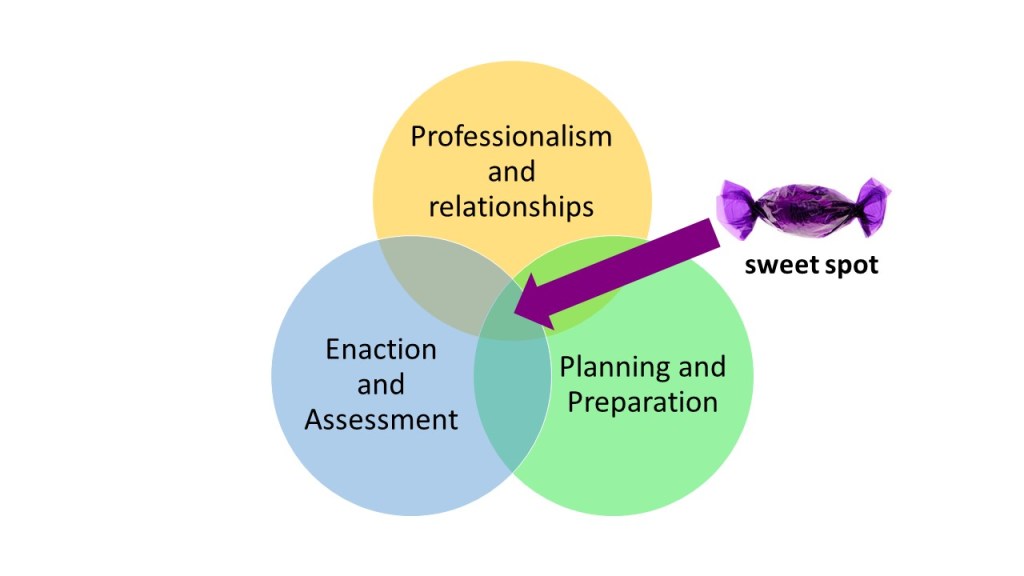
During post-observation conversations we discuss how the aim of the ITE year is to achieve the ‘sweet spot, by having all three dimensions of teacher practice in equal measure, so these dimensions can interact and create an all-round effective teacher. However, in the liminal phase of training, while moving from novice to expert, we need to recognise these dimensions develop at different rates.
A focus on enaction
For those with significant teaching experience pre-ITE (for example as Teachers of English as a Foreign Language (TEFL) or cover supervisors), it is likely that the enaction and assessment dimension (the communication and delivery of the lesson in the classroom) will be stronger than for someone entering the ITE year with no classroom experience at all.
A focus on professional behaviours
Similarly, some beginning teachers exhibit incredibly developed professional behaviours and establish highly effective relationships with colleagues and pupils, but their planning and understanding of how to sequence learning or enaction may take a little more time to ‘click’ and become effective in a classroom setting.
Thinking about practice in this multi-dimensional way enables mentors to praise their beginning teacher more authentically, establishing a relationship of trust and the feeling that you are on-side with their development journey. It helps to make the more difficult conversations about development points that little bit easier, because you create a more receptive environment when you actively identify their strengths.
“I think you’re going to be an excellent teacher”
When I read @EduCaiti ’s tweet, I was struck by the professional generosity of the Head of Department in that training placement. They did not need to be so effusive in their praise, but their words held long-lasting, career-sustaining, power. In our current recruitment and retention context we need to be proactive in creating the very best conditions for our beginning teachers to thrive. You might not feel able to say “I think you’re going to be an excellent teacher” but you might be able to say:
“I have been really impressed by your approach to getting stuck in with our team.”
OR
“The resource you made for this lesson is so much better than our current one, I’d like to look at how we might integrate into our scheme of work.”
OR
“You did so well to settle Angelica today, she often takes time to build trust with teachers, but you positively and clearly communicated your expectations which helped her have a good lesson.”
Words have power. As we get ready to meet our new mentees, let’s get off on the right foot. Let’s notice the positives.
Other blogs that may help you think through how to give specific targeted feedback:
Targeting Tom’s Transitions: Moving smoothly between phases within a lesson
References
Hobson, A. J., Malderez, A., Tracey, L., Giannakaki, M. S., Kerr, K., Pell, G., Chambers, G., Tomlinson, P., & Roper, T. (2006). Becoming a Teacher: Student teachers’ experiences of initial teacher training in England. Department for Education and Skills. http://www.dfes.gov.uk/research/data/uploadfiles/RR744.pdf
Hobson, Andrew & Malderez, Angi & Tracey, Louise & Homer, & Ashby, & Mitchell, & Mcintyre, Joanna & Cooper, & Roper, & Chambers, Gary & Tomlinson, Peter. (2009). Becoming a Teacher Teachers’ Experiences of Initial Teacher Training, Induction and Early Professional Development Final Report. 10.13140/RG.2.1.3376.3924.
Jensen. K. & Bennett, L. (2016) Enhancing teaching and learning through dialogue: a student and staff partnership model, International Journal for Academic Development, 21:1, 41-53, DOI: 10.1080/1360144X.2015.1113537
Wood, P. (2012) Blogs as liminal space: student teachers at the threshold, Technology, Pedagogy and Education, 21:1, 85-99, DOI: 10.1080/1475939X.2012.659885
 Becoming a History Teacher
3 thoughts on “Noticing the positives of beginning teachers’ practice: Supporting the transition between teaching practice placements”